Key takeaways
The short version
- Choose an isolation model from risk, customer needs, scale, and operations—not from database fashion.
- Carry verified tenant context through identity, queries, jobs, files, caches, logs, and support tools.
- Design entitlements, migrations, noisy-neighbor controls, and tenant-level observability before growth makes them urgent.
01
Define what a tenant means in the product
A tenant may be a company, workspace, legal entity, region, project, or reseller-managed customer. Define membership, invitations, ownership, transfers, suspension, deletion, and whether a user can belong to multiple tenants. Clarify which settings and data belong to the person, tenant, or platform.
These choices affect URLs, sessions, notifications, API tokens, billing, and support. Use an immutable tenant identifier internally rather than a customer name or mutable slug. Make tenant selection explicit when a user has multiple contexts, and protect against stale context across browser tabs or long-running sessions.
02
Select an isolation model from real risk and economics
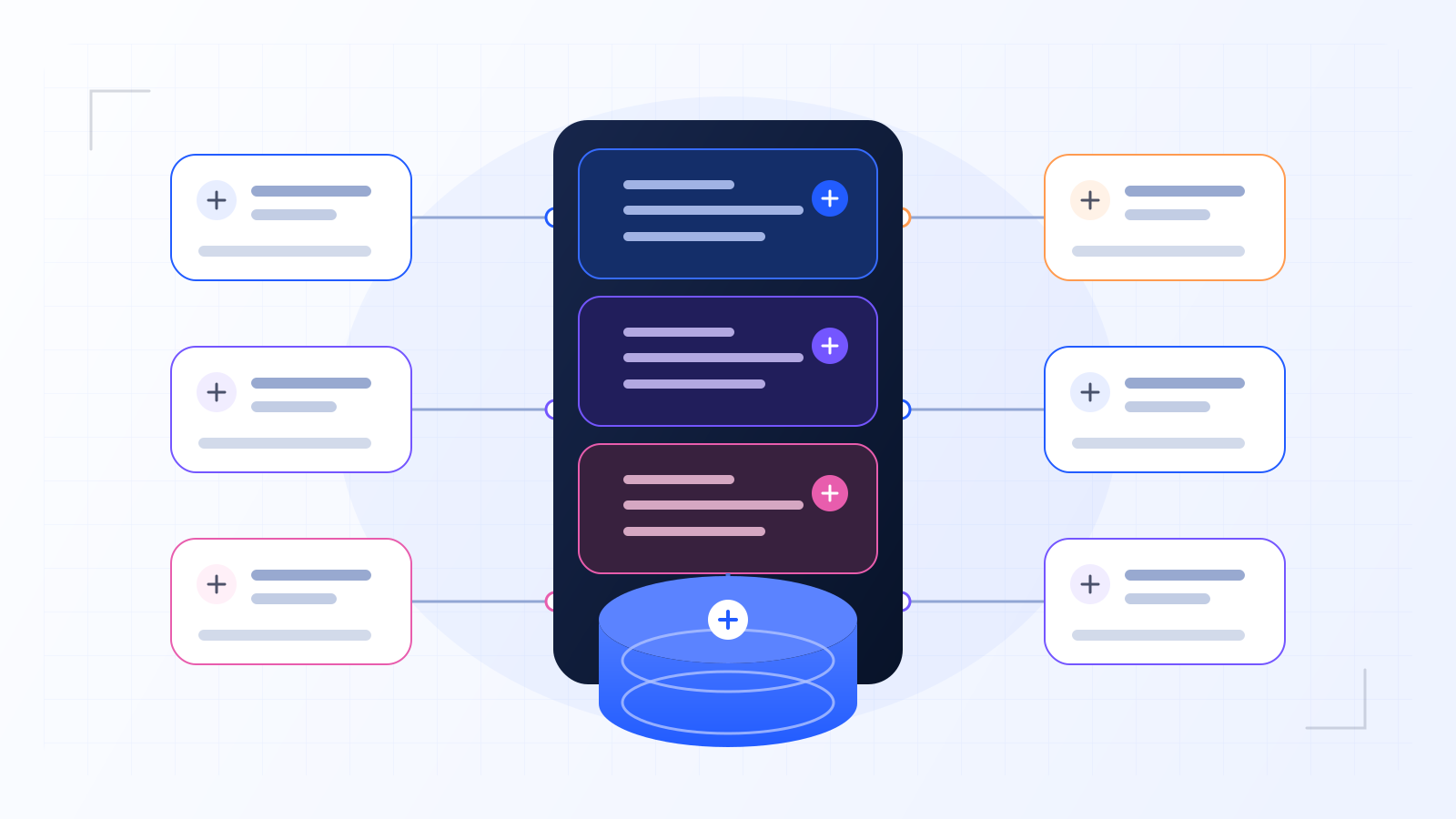
Common models include shared tables with a tenant key, separate schemas, separate databases, or dedicated application and infrastructure stacks. Shared resources can simplify onboarding and improve utilization. Dedicated resources can increase isolation, customization, and regional control, but add provisioning, migration, observability, and cost complexity.
Many products use tiers or a hybrid model. Make the placement decision policy-driven and keep application interfaces independent of the physical location where practical. Evaluate regulatory commitments, customer contracts, expected tenant size, backup and restore needs, noisy-neighbor risk, and the operating capacity of the team. Isolation is only credible when it is enforced and tested.
03
Enforce tenant context at every boundary
Derive tenant context from authenticated membership or a trusted service identity, not directly from a request field. Authorization then evaluates the user, role, tenant, resource, and action. Centralize access patterns so tenant filters are difficult to omit, and add database policies or equivalent defense in depth when they fit the platform.
Tenant context must follow background jobs, events, cache keys, search indexes, object storage paths, analytics exports, logs, and rate limits. Test cross-tenant access as a security property. Administration and support impersonation need explicit approval, narrow duration, prominent indication, and an audit trail; a hidden superuser path undermines the boundary the rest of the system protects.
04
Design migrations, retention, and recovery by tenant
Shared databases make schema evolution operationally efficient but require every query and migration to preserve isolation. Dedicated databases make tenant-level restore or placement easier but increase fleet coordination. Use versioned, backward-compatible migrations, controlled backfills, progress telemetry, and a way to pause or retry individual tenants.
Define export, deletion, retention, backup, and restore behavior as product capabilities. A platform backup may not satisfy a request to restore one customer without affecting others. Test the procedures and their timing before promising them. Preserve audit records according to policy while separating them from data that must be erased.
05
Control noisy neighbors before one tenant controls everyone
Measure resource use by tenant and workload: requests, concurrency, storage, expensive queries, background jobs, outbound calls, and generated content. Apply quotas and fair scheduling at the point of contention. A global limit can still allow one large customer to consume the entire pool.
Move expensive work to bounded queues, isolate critical workflows, and consider workload or tenant sharding when evidence shows it is needed. Make limits understandable in the product and expose safe usage information. Capacity planning should include tenant concentration because average utilization hides the risk of a few dominant workloads.
06
Align entitlements, billing, and operations without coupling them
A pricing plan is a commercial concept; an entitlement is the product capability currently allowed. Model features, limits, trials, overrides, and effective dates in a dedicated policy layer rather than scattering plan-name checks through the code. Billing events can update entitlements through explicit transitions while temporary payment issues follow a defined grace policy.
Tag metrics, traces, audit events, support history, cost, and deployment impact with safe tenant identifiers. Build dashboards for tenant health without exposing customer-sensitive information. Provisioning, suspension, region moves, plan changes, and offboarding should be idempotent workflows with visible state. Long-term growth depends as much on these operations as on request throughput.
Tenancy is the architecture of customer trust
A durable multi-tenant platform knows whose context it is serving, enforces that boundary everywhere, and can explain how data, capacity, and capabilities are managed. Making those rules explicit early keeps growth from turning a convenient shared system into an operational liability.